


Dr. Charlotte Vogt
17/09/2026
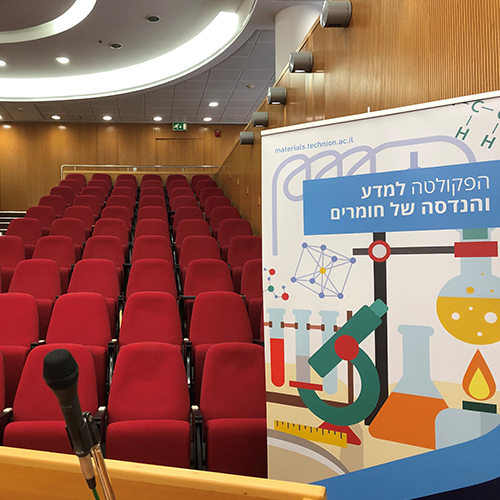
David Wang Auditorium, 3rd Floor, Dalia Maydan Bldg.
13:30
Catalysts are involved in approximately 1/3 of global gross domestic product and are key enablers for sustainable technology. Despite their exigent role, our ability to predict the function – activity, selectivity and especially stability – of working catalysts is limited. Typical industrial catalysts are incredibly complex, highly heterogeneous materials, which we commonly describe through simplified descriptions of average static structures or steady-state observables, despite the increasing realization that they are intrinsically dynamic. Adsorption, solvation, restructuring and reaction can remain strongly coupled in time even when the measured rate or average spectrum appears constant. This matters because such temporal organization reveals key information about a system’s lifetime. In this seminar, I will discuss how we use time-resolved operando spectroscopy to recover hidden temporal organization in catalytic reactions.
I will first show how controlled perturbations at electrified interfaces can reveal coupled changes in adsorbates, solvent structure and catalyst state during electrocatalytic reactions. By asking which species change together in time, without imposing assumptions of linearity or equilibrium in the data analysis, we can identify non-equilibrium interfacial states from their temporal correlations.
I will then extend this approach beyond electrochemistry to the industrial workhorse of thermal catalysis. Using CO oxidation over Pt as a model reaction with well-established spatiotemporal patterning and nonlinear dynamics, we show that photon statistics can provide a physical reference against which structured deviations in spectroscopic fluctuations can be revealed from the noise. We then apply the same approach to the Haber-Bosch process (ammonia synthesis over an industrial multipromoted Fe catalyst) using operando infrared and X-ray absorption spectroscopy at pressures up to 100 bar for over 100 h. Even after ammonia production and mean spectra approach quasi-steady behavior during prolonged operation, chemically localized fluctuations retain pronounced temporal structure. Dynamic correlations that disappear from the mean can remain encoded in the fluctuations of a working catalyst via photon statistics, providing a new route to understanding – and ultimately controlling – catalytic function.