


Ms. Basma Muhammad Haj Yahya - M.Sc. Candidate
29/03/2026
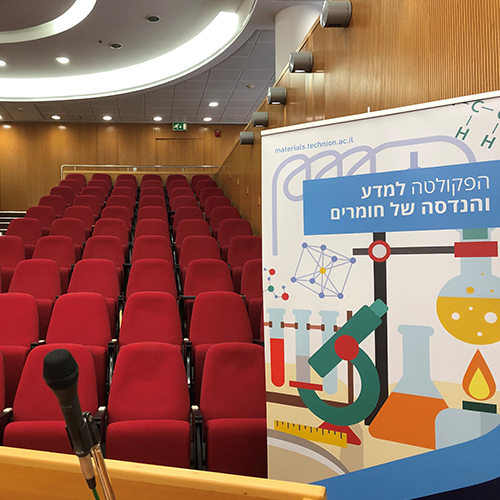
אודיטוריום ע"ש דויד וואנג, בניין מידן, קומה 3
13:30
Magnetoelectric (ME) composites combine magnetostrictive and piezoelectric materials to convert magnetic fields into electrical signals through strain-mediated coupling, offering promising routes for sensors and energy-harvesting devices. The efficiency of this coupling strongly depends on the mechanical interaction at the interface between the two layers. Previous simulations performed in our group predicted that modifying the interface from a flat surface to a patterned geometry, such as grating lines, could enhance strain transfer and improve device performance.
In this work, I experimentally examine these predictions using Ni–PVDF composites. Periodic grating patterns were introduced into the PVDF surface using silicon molds and a cold-pressing process, applying forces in the range of 2–10 kN. The piezoelectric coefficient d₃₃ was monitored using a piezometer to ensure that the fabrication preserved the material’s piezoelectric response. The patterned PVDF was then bonded to a nickel layer to form ME composites, and magnetoelectric measurements were performed on patterned, flat-pressed, and unpressed samples. In addition, the effect of the applied pressing load during fabrication was also investigated.
The results show that controlling the interface geometry and bonding pressure enhances operational strain transfer and leads to improved ME coupling and mechanical quality factors compared to flat interfaces. These results show that interface engineering is an effective strategy for optimizing magnetoelectric composite devices and experimentally confirm simulation predictions.